KRA Full Form in HR: Meaning, Examples & Smart KRA
Employee performance is not just about completing assigned tasks. Organizations need a clear way to define expected outcomes, measure contribution, and connect individual performance with larger business goals.
This is where KRAs play an important role. Understanding the KRA full form and how KRAs work can help organizations create a more structured and measurable approach to employee performance.
KRA Full Form and Meaning?
KRA stands for Key Result Area. It defines the key areas where an employee is expected to deliver specific results as part of their role.
In HR, a KRA represents the important responsibilities or outcome areas that contribute to an employee's overall performance. Instead of evaluating an employee on every task they perform, KRAs focus attention on the results that matter most for their role.
A well-defined KRA gives employees clarity about what they are expected to achieve and gives managers a structured basis for performance evaluation. When KRAs are connected with a Performance Management System , they can also be linked with goals, measurements, ratings, and organizational objectives.
Key Features of KRAs
Effective KRAs are designed to make employee expectations clear, measurable, and relevant to the organization's objectives.
- Clear Performance Expectations: KRAs clearly define the key result areas an employee is responsible for, reducing confusion about what needs to be achieved.
- Measurable Outcomes: A good KRA can be connected with specific targets or measurable values, making performance easier to track and evaluate.
- Role-Based Relevance: KRAs should reflect the employee's actual role, responsibilities, department, and level within the organization.
- Goal Alignment: KRAs can connect individual responsibilities with departmental and organizational goals, creating better alignment across different levels.
- Performance Evaluation: KRAs provide a structured foundation for reviewing employee performance and understanding whether expected results have been achieved.
Why Does KRA Matter in an Organization?
KRAs help organizations move from general performance expectations to clearly defined areas of employee contribution.
- Creates Accountability: Clearly defined KRAs help employees understand the results they are responsible for and create greater ownership of their performance.
- Improves Performance Clarity: Employees and managers have a common understanding of expectations, targets, and important areas of contribution.
- Supports Fair Evaluation: Measurable KRAs can provide a more consistent basis for evaluating performance instead of depending only on general observations.
- Connects People With Business Goals: When KRAs are aligned with organizational objectives, individual efforts can contribute more directly to broader business priorities.
Traditional KRA vs. Smart KRA: What’s the Difference?
Traditional KRA management can become difficult when KRAs are created manually, remain too generic, or depend heavily on subjective evaluation. Employees may have responsibilities listed as KRAs without a clear measurement value, business connection, or defined importance. This can make it harder to understand how individual performance contributes to organizational results.
PrajjoHR takes a different approach with Smart KRA within its Performance Management System. Instead of treating KRA as only a performance-review requirement, PrajjoHR connects KRAs with business drivers, measurable values, KPA alignment, structured weightage, and predefined KRA inventories. This creates a more connected approach to defining and evaluating employee performance.
| Feature | Traditional KRA | PrajjoHR Smart KRA |
|---|---|---|
| KRA Type | Generic, one-size-fits-all | Role-wise, department-wise, and group-wise KRA types |
| Business Alignment | Rarely connected to business goals | Every KRA is mapped to a Business Driver and aligned to KPI |
| Measurement | Vague or manager's judgment | Quantifiable KRA with exact rating and react value |
| KRA Setup | Manual, built from scratch | Ready-to-use, predefined KRA inventory and sheets |
| Weightage | Often missing or inconsistent | Structured weightage assignment for every KRA |
| Mandatory Tracking | Optional, easy to skip | Mandatory KRA enforcement for critical roles |
What Actually Makes a KRA "Smart"?
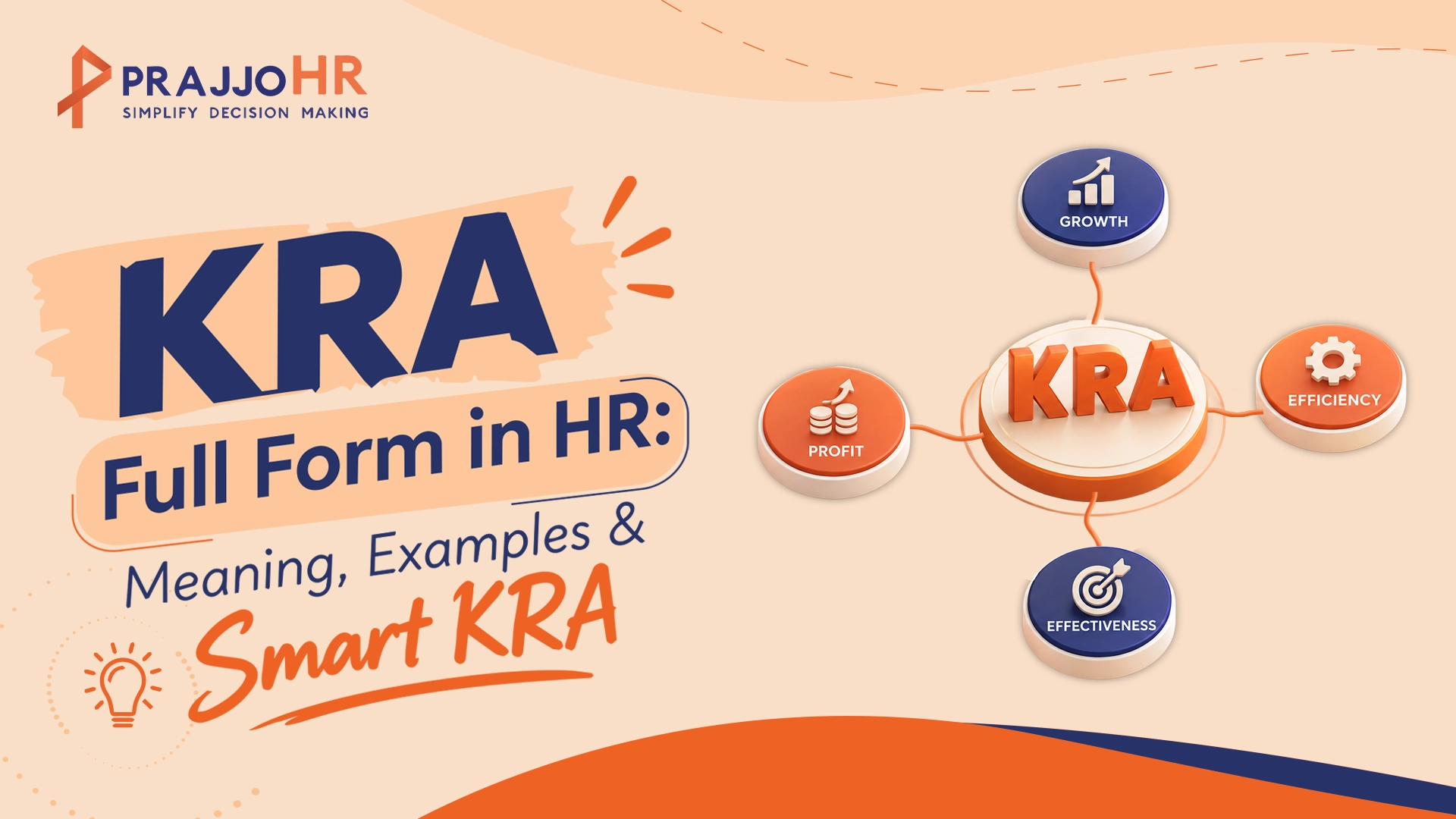
A KRA becomes more meaningful when it is connected to the business drivers that influence organizational performance. PrajjoHR's Smart KRA approach uses GEPE - Growth, Effectiveness, Efficiency, and Profit to give KRAs a clear business perspective.
- G - Growth: Connects employee outcomes with business expansion, revenue growth, and new opportunities.
- E - Efficiency: Focuses on achieving better results through effective use of time, resources, and processes.
- P - Profit: Connects relevant employee outcomes with profitability, revenue contribution, and cost optimization.
- E - Effectiveness: Focuses on whether the employee's work is producing the intended business or operational outcome.
By connecting a KRA with a business driver, organizations can look beyond whether a task was completed and understand the broader result it supports. This helps create a stronger connection between employee performance, KPA alignment, and business objectives.
How KRA Supports Different Areas of HR Management
KRA is not limited to annual performance reviews. When properly structured, it can support different areas of HR by creating clearer expectations and measurable outcomes.
Performance Management
KRAs provide a structured foundation for setting goals, measuring results, assigning weightage, and evaluating employee performance. They help managers assess performance against defined expectations rather than relying only on general observations.
Recruitment Management
KRAs can help organizations define performance expectations for recruitment roles through a recruitment management system , such as hiring targets, time-to-hire, quality of hire, or recruitment efficiency. This makes it easier to connect recruitment responsibilities with measurable outcomes.
Employee Engagement
Clear performance expectations can help employees understand how their work contributes to the organization. When employees know their goals and how their contribution is measured, it can improve employee engagement and make performance conversations more focused and meaningful.
Attendance Management
Attendance-related KRAs can be managed effectively with an attendance management system where punctuality, attendance compliance, shift adherence, or workforce availability are relevant performance requirements. These measurable expectations can support better workforce discipline, accountability, and attendance tracking.
Building Company Culture
A KRA framework can reinforce the behaviors and outcomes that an organization considers important. When business priorities and employee expectations are consistently aligned, KRAs can support a culture of accountability, ownership, and performance.
Why Choose Prajjo HR for Smart KRA Management?
PrajjoHR brings KRA management into a broader performance management framework where employee outcomes can be connected with business priorities. Its Smart KRA approach focuses on measurable performance, business-driver alignment, structured KRA inventories, and clear performance evaluation.
- Business-Driver Aligned KRAs: Every KRA connects employee responsibilities and outcomes to Growth, Effectiveness, Efficiency, and Profit (GEPE).
- Quantifiable KRAs: Every rating is supported by an exact, measurable value, creating greater clarity around performance evaluation.
- Ready KRA Inventory: Every role can use pre-defined KRAs organized by role, department, and group, reducing repetitive KRA creation.
- Mandatory & Weighted KRAs: Critical responsibilities can be marked mandatory and assigned the right weight based on their importance.
- KPA-Aligned Performance: KRAs can be connected with relevant KPAs so that individual performance remains aligned with larger performance objectives.
Conclusion
The KRA full form is Key Result Area, and KRAs play an important role in defining what employees are expected to achieve within their roles. When KRAs are clear, measurable, and aligned with organizational goals, they can provide a stronger foundation for performance evaluation.
However, modern performance management requires more than simply maintaining a list of KRAs. Smart KRA takes the concept further by connecting KRAs with measurable values, KPA alignment, weightage, predefined inventories, and business drivers.
With its GEPE framework - Growth, Effectiveness, Efficiency, and Profit. PrajjoHR Smart KRA brings a business-focused approach to performance management, helping organizations connect employee contribution with the outcomes that matter to the business.
Frequently Asked Questions About KRA
What is the full form of KRA in HR?
The KRA full form is Key Result Area. It represents an important area in which an employee is expected to achieve specific results as part of their role.
What is KRA in HR?
KRA defines the key result areas or important outcome areas associated with an employee's role. It helps organizations establish clear expectations and evaluate employee performance.
What is the difference between KRA and KPI?
A KRA defines the important result area, while a KPI is a measurable indicator used to track or evaluate performance within that area.
What is Smart KRA?
Smart KRA is a structured approach to KRA management that focuses on measurable outcomes, business alignment, KPA alignment, weightage, and relevant performance evaluation.
What is GEPE in Smart KRA?
GEPE represents Growth, Effectiveness, Efficiency, and Profit. These business drivers provide a framework for connecting employee KRAs with broader business outcomes.
Experience Next-Generation
HR Software in Action
People-Centric HRMS: AI That Aligns Mission, People & Performance