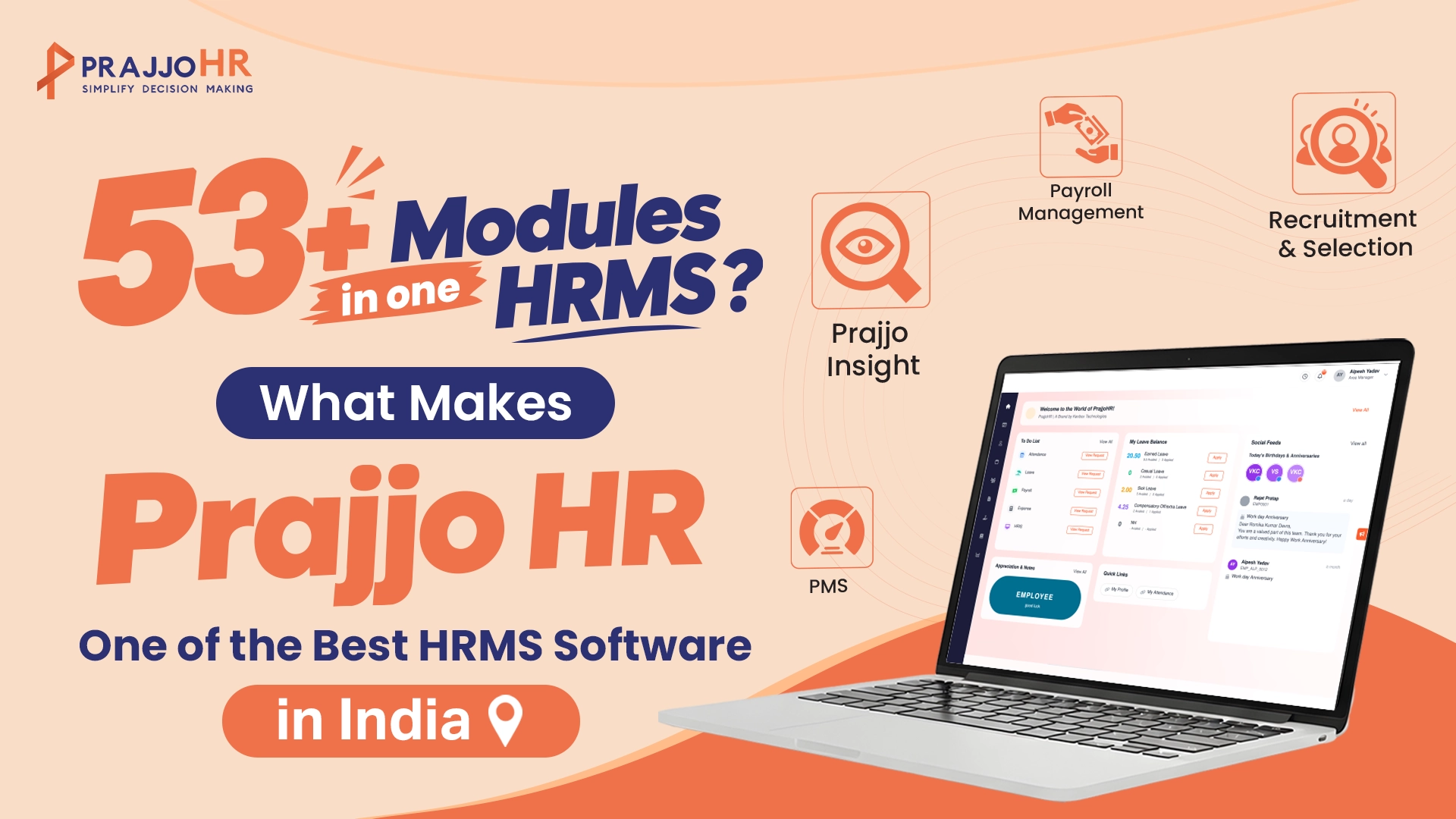
53+ Modules in One HRMS? What Makes Prajjo HR One of the Best HRMS Software in India
Managing employees today involves much more than maintaining records, tracking attendance, or processing salaries. HR teams handle recruitment, onboarding, payroll, performance, engagement, learning, and many other responsibilities that keep an organisation running smoothly.
As these responsibilities continue to grow, businesses need an HRMS that can manage different processes from one connected platform instead of relying on multiple separate tools.
For businesses searching for the best HRMS software in India, the real value lies in how well an HRMS can bring different functions together. With 53+ modules, Prajjo HR covers core HR, recruitment, onboarding, attendance, payroll, performance, workforce productivity, and other business requirements in one ecosystem.
What Makes an HRMS Truly Complete?
A complete HRMS should cover more than basic employee administration. It should support the journey from recruitment and onboarding to attendance, payroll, performance, development, and employee engagement
It should also help different teams work with connected information instead of moving data between separate systems. When HR, managers, payroll teams, recruiters, and employees can access the information they need from one ecosystem, everyday HR processes become easier to manage.
What “53+ Modules” Really Means?
The number 53+ is not simply a long list of features added to make an HRMS look bigger.[Text Wrapping Break]It represents a wider set of HR, employee, business, and workforce management functions available within the Prajjo ecosystem.
Here are some of the major areas covered:
- Core HR Management - Centralised employee information, employee records, organisational structures, and essential HR operations.
- Recruitment Management - Manpower requisitions, job openings, candidate sourcing, applicant tracking, screening, interviews, and offers.
- Onboarding Management - Joining workflows, document collection, verification, communication, induction, and employee creation.
- Attendance Management - Attendance tracking, shifts, working hours, overtime, holidays, late marks, and attendance reporting.
- Leave Management - Leave applications, approvals, balances, leave history, and attendance integration.
- Payroll Management - Salary processing, pay structures, deductions, payroll cycles, settlements, and statutory requirements.
- Performance Management - Goals, KRAs, appraisals, ratings, competency assessments, calibration, and performance analytics.
- Learning & Development - Training requirements, learning plans, training activities, and development tracking.
- Employee Engagement - Processes and tools designed to support employee participation and engagement.
- Culture Management - Functions that help organisations manage and strengthen workplace culture.
- Compensation & Benefits - Management of employee compensation-related processes and benefits.
- People Analytics - Workforce information and analytics that can support people-related decisions.
- Prajjo Connect - Employee-facing and workforce management capabilities through web and mobile access.
- Prajjo Insight - Workforce productivity intelligence, employee activity monitoring, analytics, and endpoint security.
- Business Enhancement - Business-focused capabilities that extend the platform beyond traditional HR administration.
So, 53+ modules means businesses can address different HR and workforce requirements without treating every process as a separate system.
The important part is not simply having more modules. It is having them within one connected HR ecosystem.
What Can Your Business Do With 53+ HR Modules?
A wider HRMS can help businesses manage different workforce activities without creating separate processes for every department.
Here are some practical ways these modules can support your organisation:
1. Manage the Employee Lifecycle
Businesses can connect recruitment, onboarding, employee records, attendance, payroll, performance, and development as employees move through different stages of their journey.
2. Reduce Dependence on Multiple Tools
Instead of maintaining separate systems for different HR functions, businesses can bring more processes into one platform and reduce unnecessary movement of employee information.
3. Connect HR Data Across Departments
Recruitment, HR, managers, payroll teams, and employees can work with information that is connected across different HR processes rather than being maintained in isolated systems.
4. Improve Workforce Visibility
Beyond basic HR records, businesses can use performance, attendance, analytics, and workforce productivity information to understand what is happening across teams.
5. Support Better HR Decisions
When employee and workforce information is available across different functions, HR and business leaders can use that information to identify trends, review performance, and plan workforce activities.
Why Choose Prajjo HR for Complete HR Management?
Prajjo HR brings together the major HR functions businesses need while also extending into performance, productivity, analytics, and workforce management.
The focus is not only on completing individual HR tasks but on connecting these activities throughout the employee lifecycle.
Core HR
Core HR acts as the foundation for employee information across the organisation. An HR management system provides a central place to manage employee records, organisational information, roles, and other essential HR data.
When this information is connected with other modules, HR teams do not need to repeatedly maintain the same employee details across different systems.
It also gives other HR functions a common employee-data foundation, helping recruitment, onboarding, attendance, payroll, and performance processes work around connected employee information.
Performance Management System
Prajjo HR's Performance Management System helps organisations manage performance through goals, KRAs, reviews, ratings, and development activities.
It supports goal cascading, KRA management, goal weightage, competency assessments, self and manager appraisals, and multi-level review workflows.
It also includes performance calibration, Bell Curve normalization, 9-Box Matrix, succession planning, 360-degree feedback, and performance analytics to give organisations a wider view of employee performance.
Recruitment Management System
Recruitment becomes easier to manage when job requirements, candidates, interviews, evaluations, and offers are handled through one recruitment workflow.
Prajjo HR's Recruitment Management System includes manpower requisitions, hiring approvals, job openings, candidate sourcing, referrals, candidate pools, and an integrated Applicant Tracking System.
It also supports resume parsing, AI-enabled resume screening, CV Fitment Scoring, interview scheduling, candidate evaluations, and digital offer management, helping recruiters manage the hiring journey from one place.
Attendance Management System
Attendance is closely connected with working hours, leave, shifts, overtime, and payroll. Managing these processes together can help businesses maintain more consistent workforce records.
Prajjo HR supports biometric, mobile, and web-based attendance along with shift scheduling, rotational shifts, late marks, early exits, overtime calculations, holidays, and weekly-off settings.
Attendance management system can also connect with leave and payroll processes, allowing approved leave and attendance information to flow into payroll calculations instead of requiring repeated manual updates.
Payroll Management System
Payroll requires accurate employee information, attendance records, salary structures, deductions, and other payroll-related data to come together at the right time.
Prajjo HR's Payroll Management System is designed to manage salary processing and related payroll activities through a centralised system, helping businesses manage recurring payroll requirements more systematically.
When payroll is connected with attendance and employee information, HR and payroll teams can work with the relevant workforce data without maintaining completely separate records for every process.
Onboarding Management System
The employee journey does not end when a candidate accepts an offer. The onboarding process still involves documentation, verification, communication, joining activities, and employee creation.
Prajjo HR's Onboarding Management System supports onboarding plans, joining checklists, scheduling, induction planning, digital document collection, verification, and communication.
Once the employee joins, onboarding information can move into Core HR and connect with other HR processes, creating a smoother transition from candidate to employee.
Prajjo Insight: The Part Most HRMS Platforms Simply Don't Have
Traditional HRMS platforms generally focus on employee records and HR processes. Prajjo Insight extends the ecosystem into workforce productivity, activity visibility, analytics, and endpoint security.
It is designed to help organisations understand how work is happening while also bringing productivity and security information into the wider Prajjo ecosystem.
1. AI-Powered Workforce Productivity
Prajjo Insight uses workforce analytics and AI-powered productivity insights to help organisations understand productivity patterns across employees and teams.
It can provide information such as active and idle time, productivity scoring, performance trends, and peak productivity hours.
2. Real-Time Employee Activity Monitoring
The platform provides visibility into employee work activity through application and website usage tracking, activity timelines, smart screenshots, and user activity history.
This can be particularly useful for organisations managing office, remote, or hybrid teams that need a centralised view of workforce activity.
3. Remote and Hybrid Workforce Visibility
Managing a distributed workforce can make it harder for businesses to understand work patterns from traditional attendance information alone.
Prajjo Insight provides remote and hybrid workforce analytics, work-from-home activity tracking, and location-independent workforce visibility through a centralised platform.
4. Endpoint Security and Data Protection
Workforce productivity is only one side of the equation. Businesses also need to protect the information employees access and use.
Prajjo Insight includes capabilities such as USB and external device monitoring, website filtering, web access control, data encryption, device controls, offline activity monitoring, and Data Loss Prevention features.
5. Connected Workforce Insights
Prajjo Insight can work with the wider Prajjo HR ecosystem, connecting workforce productivity information with Core HR, attendance, and payroll.
This creates a broader view where HR information, attendance, payroll, productivity, and workforce insights can be considered together instead of being kept in completely separate systems.
The Logic Behind It: Why One System Beats Many.
Using multiple HR tools often means employee information is spread across different platforms, making it harder for teams to keep processes connected.
With one connected HR ecosystem, businesses can manage more HR activities together while keeping relevant employee information available across different functions.
- One employee record: Employee information can remain connected across different HR processes.
- Connected workflows: Recruitment, onboarding, attendance, payroll, and performance can work as part of the same ecosystem.
- Less repetitive work: HR teams can reduce the need to enter or maintain the same information across multiple systems.
- Better workforce visibility: HR and management teams can access information from different areas to understand their workforce more clearly.
Is Prajjo HR Right for Your Business?
Prajjo HR can be useful for businesses that want more than basic employee administration and need a wider HR and workforce management platform.
If your organisation is managing recruitment, onboarding, attendance, payroll, performance, learning, engagement, and other workforce processes through different tools, bringing more of them into one ecosystem can simplify how information is managed.
It can also be relevant for businesses that want to look beyond traditional HR data. With Prajjo Insight, organisations can add workforce productivity, activity monitoring, analytics, and endpoint security to their broader HR environment.
The right HRMS ultimately depends on your organisation's size, workforce structure, HR requirements, and the processes you want to manage. For businesses looking for a platform that covers a broad range of HR and workforce functions, Prajjo HR brings these requirements together through its 53+ module ecosystem.
Conclusion
Choosing an HRMS is not only about counting how many features appear on a product page. The more important question is whether those features cover the processes your business actually manages every day.
With 53+ modules, Prajjo HR brings Core HR, recruitment, onboarding, attendance, payroll, performance, learning, engagement, compensation, analytics, workforce productivity, and other business functions into one broader ecosystem.
And with Prajjo Insight, the platform goes beyond conventional HR management by adding workforce productivity intelligence, employee activity monitoring, analytics, and endpoint security.
For businesses evaluating the best HRMS software in India, this broader approach can be worth considering: not just how many HR functions a platform has, but how many workforce requirements it can bring together in one connected system.
Frequently Asked Questions
1. What is the best HRMS software in India?
The right HRMS depends on the organisation's workforce size, HR processes, industry requirements, and the functions it needs to manage. A complete HRMS should ideally cover areas such as Core HR, recruitment, onboarding, attendance, payroll, performance, employee engagement, and workforce analytics.
2. What are 53+ modules in Prajjo HR?
Prajjo HR's 53+ modules cover a broad range of HR and workforce requirements, including Core HR, recruitment, onboarding, attendance, payroll, performance management, learning and development, employee engagement, compensation and benefits, culture, people analytics, Prajjo Connect, Prajjo Insight, and business enhancement functions.
3. How does Prajjo HR go beyond a traditional HRMS?
Prajjo HR extends beyond basic HR administration by combining core HR functions with recruitment, performance management, workforce productivity, analytics, and specialised solutions such as Prajjo Connect and Prajjo Insight.
4. What is Prajjo Insight?
Prajjo Insight is an AI-powered workforce productivity and endpoint security platform. It provides workforce analytics, employee activity monitoring, productivity insights, remote and hybrid workforce visibility, and security capabilities such as device monitoring, web access control, data encryption, and Data Loss Prevention.
5. Can Prajjo HR connect attendance, payroll, and employee information?
Yes. Prajjo HR is designed as a connected HR ecosystem where functions such as Core HR, attendance, payroll, recruitment, onboarding, performance, and workforce insights can work together. This helps businesses reduce the need to maintain completely separate information across different HR processes.
Experience Next-Generation
HR Software in Action
People-Centric HRMS: AI That Aligns Mission, People & Performance